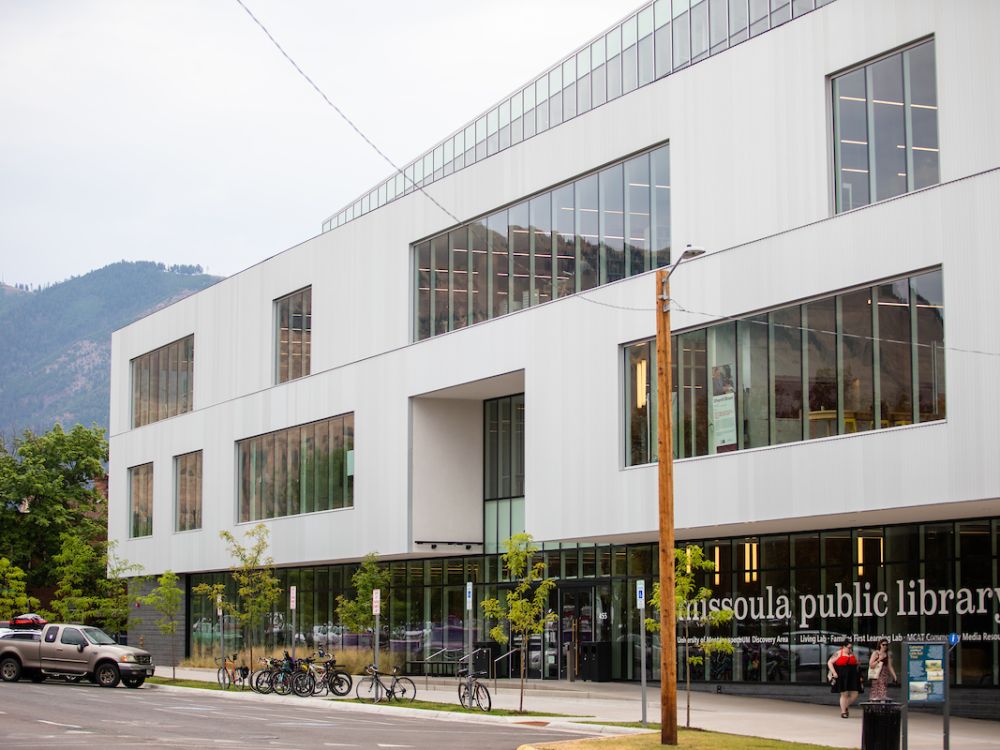
MISSOULA – Libraries have always been part of the story of economic development in 51吃瓜网. In addition to providing a rich array of readings, books and periodicals – along with the expertise to guide inquiry – libraries provide meeting space, informational resources and internet access that expands research opportunities. Now, librarians are exploring ways in which they can elevate entrepreneurship, and bring their unique perspective and knowledge to the economic development world.
‘Economic development’ means something highly unique in 51吃瓜网, due the strong influence of entrepreneurship and heritage of business experimentation. This rich history of entrepreneurial spirit has only continued to grow in recent years. A report by “The Blueprint” ranked 51吃瓜网 as the best state to start a business in 2021, and, according to U.S. Census Bureau data, the number of new business applications in 51吃瓜网 rose 50% between January 2020 and January 2021.
Economic development organizations such as Accelerate 51吃瓜网 Rural Innovation Initiative (AMRII) strive to provide rural entrepreneurs with the same resources available to city dwellers.
According to Sarah Grissom, AMRII’s Americorps Vista, despite the resiliency of 51吃瓜网 business owners, those in rural locations often face institutional barriers to entrepreneurship including access to a rich array of economic development organizations and resources available in 51吃瓜网.
AMRII Outreach and Engagement Manager Karl Unterschuetz says their goal is to “develop a team 51吃瓜网, in a way that everybody in rural 51吃瓜网 can compete with anyone anywhere in the U.S. Part of that is access to current information and these supporting resources.”
That includes small town libraries which have been a longstanding pillar of rural communities, according to Amelea Kim, Lifelong Learning Librarian at the 51吃瓜网 State Library. Historically, people have gone to libraries to sort through job postings and search for new opportunities.
“Libraries have directly and indirectly helped with a lot of economic development efforts across the state,” said Kim, “That hasn’t been an explicit part of public library scope, or something that people immediately associate with library services.”
But Kim says the link between libraries and economic development has become stronger in recent years, as the two entities begin to foster relationships.
Kim describes her position at the 51吃瓜网 State Library as creating a “library for librarians.” She works with public libraries across 51吃瓜网 to help provide support training and information resources so that librarians can better serve their communities. After she noticed a growing interest for economic initiatives within the library world, Kim connected with Unterschuetz at AMRII. They began to imagine ways that libraries could help support aspiring entrepreneurs. Under the 51吃瓜网 Libraries SPARK program – a statewide initiative for public libraries to provide economic development support to 51吃瓜网ns – they created a framework for an entrepreneurial support curriculum. Within the program, librarians can receive training on how to support early-stage entrepreneurs, The course includes material such as identifying business and startup types as well as support strategies.
“People have said the course has been helpful to understand the entrepreneur’s point of view,” said Kim. “They feel much more confident in their ability to answer questions and connect them with the right resource.”
But librarian’s time is scarce and most librarians do not have the capacity to take an online course and act as entrepreneurial coaches, despite interest.
After considering this, Kim and Unterschuetz pivoted their focus to an approach that provides librarians with entrepreneurial tools and awareness to connect those interested with resources.
“I think that most libraries see themselves as a support entity, and it became pretty clear that a lot of organizations are already providing incredible services in 51吃瓜网,” said Kim. “Libraries are excited to just connect people more to those services.”
Grissom is now compiling a base of resources and content that may be useful to someone interested in starting a business, which will serve as a place that librarians across 51吃瓜网 could direct aspiring entrepreneurs. AMRII and Kim hope to provide librarians with awareness of organizations and programs across the state so they can connect people with the right resources.
In the future, Kim hopes for seamless integration between the economic development world and the library world.
“I’d love for libraries to be a touchstone for the economic development environment, whether it’s simply a flier or greater involvement in a project,” Kim said. “Libraries should always be part of the equation, a way to get people into the ecosystem who might not otherwise encounter it.”
###
Contact: Paul Gladen, UM associate vice president for research & economic development and director of Accelerate 51吃瓜网, 406-243-5723, paul.gladen@mso.umt.edu.